
To test whether a late entrant can realistically gain traction in an established B2B market, we mapped the competitive digital footprint of Microplastic Analysis—a high-stakes topic dominated by legacy molecular spectroscopy vendors (FTIR and Raman microscopy), academic research hubs, and consumer curiosity.
Instead of looking at search volume in a silo, we conducted a cross-channel data scrape to evaluate where Google Search, Google AI Overviews, and YouTube overlap, and where competitors have left blind spots.
The Core Hypothesis
Hypothesis: Can a brand find success in a niche application/market by creating a video first content strategy?
Dataset & Search Matrix
I built a matrix of 51 targeted search phrases spanning three distinct stages of user intent:
- Top-of-Funnel / Broad Awareness: Broad public and lab questions (e.g., “Are microplastics in tap water?”, “Microplastics filtration systems”).
- Mid-Funnel / Workflow & Sample Prep: Practical laboratory execution and handling (e.g., “Microplastic digestion protocols”, “Filter selection for Raman microscopy”, “Water sample preparation”).
- Bottom-of-Funnel / Commercial Intent: System-specific purchasing and technology queries (e.g., “Automated microplastics analysis FTIR”, “Infrared microscope microplastics”).
Data Collection & Scraping
I harvested the top 10 search results for each query across two primary surfaces:
- Google Search Engine Results Pages (SERP): Scraped both classic organic “10 blue links” and citations embedded inside Google AI Overviews (AEO/GEO).
- YouTube Search: Scraped top-ranking video results, logging video counts, average views, and channel entities.
In total, the scrape surfaced 485 unique entities and domains across 603 search citations and hundreds of video listings.
Taxonomy & Entity Categorization
To understand who actually owns the conversation, we classified every ranking source into one of ten operational categories:
- Instrument Vendors: Analytical hardware, spectroscopy, and optics manufacturers (e.g., Shimadzu, Bruker, HORIBA, Thermo Fisher).
- Academic Journals & Publishers: Peer-reviewed repositories and databases (e.g., ScienceDirect, Nature, ACS Publications, PubMed).
- Universities & Research Labs: Higher-ed research departments and non-profit marine laboratories.
- Trade Media: Analytical chemistry portals and instrumentation trade magazines (e.g., Spectroscopy Online, Technology Networks).
- Digital Platforms & YouTube: Search aggregators (Google Scholar), social networks, and direct YouTube video links indexed on web SERPs.
- Independent Creators & Podcasts: Science communicators, educational channels, and independent researchers.
- Commercial Testing Labs & Regulators: Fee-for-service testing labs, EPA, and EU environmental agencies.
Findings
In my study, the key opportunity wasn’t hitting the target keyphrase related to microplastic imaging; it was sample preparation for microplastics and how B2B brands focus on analysis rather than collection and preparation. Now, don’t get me wrong: if a brand wants to compete in this space, they need a video focused on the features and benefits of their microscope for this analysis, BUT that’s the endpoint in the user buying journey. More and more, we are seeing brands that stand out and provide value to their potential users before the buying transaction even takes place.
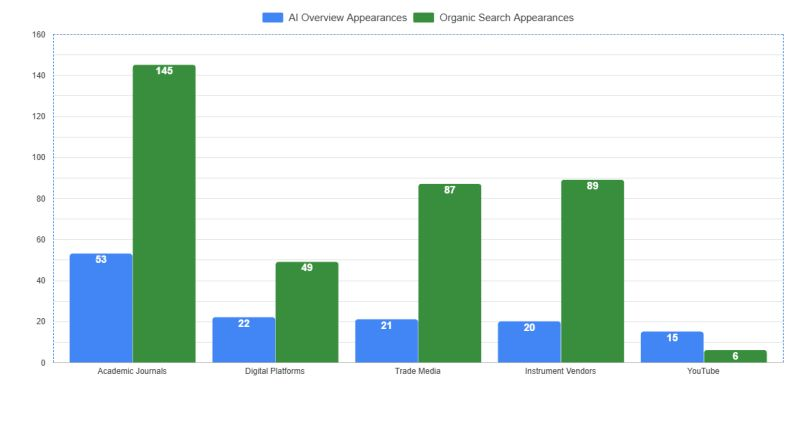
Well, what if a brand wanted to build a series around this topic to broaden coverage and build a search funnel, so it does double duty on search and YouTube? If a brand followed this approach, you would get total coverage on the topic… as long as the creative can support the message. On the search side, the results got interesting: of the 51 key phrases, only 6 showed a direct link back to YouTube.
Another notable point is that brands with fewer pages ranked higher because they had one beefed-up webpage.
AI overviews showed a much different story than the search landscape. Scientific research papers were cited over 62% of the time in overviews, while brands were mentioned 33%. As AEO and GEO continue to grow and evolve, brands will need to focus not only on managing webpages and social channels, but also on partnering with researchers who conduct and publish research papers to break into an emerging market.
Key Takeaway Box (Optional Sidebar/Callout)
By the Numbers:
- 51 search queries analyzed across Google & YouTube
- 485 unique source domains and creator channels mapped
- 62% vs. 33%: AI Overviews cited peer-reviewed research papers nearly twice as often as commercial brand domains
- 6 of 51: Only ~12% of technical search queries returned video carousels on the main Google SERP, proving that video must be paired with high-intent written pillar content to capture search traffic


Leave a Reply